SERVFORU

Latest Post
Showing posts with label Hacking. Show all posts

Digital Steganography: Hiding Data within Data - MATLAB Program

Uses of Steganography

Steganography is a means of storing information in a way that hides that information’s existence. Paired with existing communication methods, steganography can be used to carry out hidden exchanges. Governments are interested in two types of hidden communications: those that support national security and those that do not. Digital steganography provides vast potential for both types. Businesses may have similar concerns regarding trade secrets or new product information. Avoiding communication in well-known forms greatly reduces the risk of information being leaked in transit.

Images as Carriers
Images are a good medium for hiding data (for details, see Pan, Chen, and Tseng 3 ). The more detailed an image, the fewer constraints there are on how much data it can hide before it becomes suspect. The JPHide/JPSeek package (http://linux01.gwdg.de/~alatham/stego.html) uses the coefficients in a JPEG to hide information. A newer method (http://www.know.comp.kyutech.ac.jp/BPCSe/BPCSe-principle.html) embeds data in visually insignificant parts of an image. Both of these methods alter the image; however, you can explore image degradation using different images and messages of varying length. An alternative, specific to GIF images, is to manipulate an image’s palette in order to hide data. Gifshuffle (http://www.darkside.com.au/gifshuffle/) does not alter the image itself in any visible way; rather, it permutes a GIF image’s color map, leaving the original image completely intact


Here is the matlab code for stegnography . both encode and decode 

download it from github https://github.com/ebine/stegnography/


VibeApp Hack your email contacts , Grab everything you need to know about your email contacts

I was confused always when I get emails from unknowns , i stuck at finding the sender behind the craps , now I got a simple solution and that is vibeApp

And just in a simple hover the cursor over the email adress all about the email id is listed , everything the twitter handle , facebook  , linkedin  Google+, and even a web page they are most likely to be associated with


Hello Vibe is an application that more accurate and simple to use  know about the information about the email contacts , now its available for chrome and mac

Download it and know the people behind you
http://vibeapp.co/#/home
 

Reset Android Smartphone Pattern/Password/Pin lock

It sucks when you forget your passwords But Gmail account can save you. But what for those who don't have it? 
There are some methods to reset them
Wiping data being most popular 
But, why loosing precious data when there is a easier or easiest to do method 

This is a new method found and tested by me on a rooted device but the resources it uses are available to be used without root too, so it may work on unrooted devices too. 


This method uses Aroma File Manager by amarullz in Recovery Mode of the device to delete the password database related files. So, it should work on all devices! 


So, first you need to download AROMA FILE MANAGER from here 


Instructions:-


1. Download Aroma File Manager.
2. Place it in the root of your sdcard(Preferred)
3. Reboot into recovery
4. For CWM:


Mount all partitions (including sd-ext if you have it)

And flash Aroma File Manager from sdcard

For stock recovery(Samsung e3):


In stock recovery, there is no option to mount partitions, so

Flash Aroma File Manager, Click on menu option and go to settings

Select Mount All Partitions

Now, exit from Aroma File Manager and reflash it.

Now, you will see each partition is mounted


5. Now, go to /data/system

Note : If you have sd-ext mod to increase internal storage, go to /sd-ext/system/


6. Now, If you have to remove pattern lock, long press and delete gesture.key

If you want to remove password, delete password.key
7. Exit the Aroma File Manager
8. Reboot 


Encode your secret messages in Your Facebook Pics

Facebook is a place where you can share pictures of cute animals and fun activities. Now there’s a browser extension that lets you encode those images with secret, hard-to-detect messages.  With the extension, anyone — you, your sister, a terrorist — could share messages hidden in JPEG images uploaded to Facebook without the prying eyes of the company, the government or anyone else noticing or figuring out what the messages say. The only way to unlock them is through a password you create.

The goal of this research was to demonstrate that JPEG steganography can be performed on social media where it has previously been impossible,” Campbell-Moore tells Danger Room. He says he spent about two months spread out over the last year working on the extension as a research project for the university.


The extension is only available for the Google Chrome browser — Campbell-Moore cites its developer tools and popularity — and the messages are restricted to 140 characters. Less certain is what Facebook thinks; a spokesman declined to comment. But it’s still the first time anyone’s managed to figure out how to automate digital steganography — the practice of concealing messages inside computer files — through Facebook, the world’s biggest social media platform. Unlike cryptography, which uses ciphertext to encrypt messages, steganographic messages are simply hidden where no one would think to look.


How to do 

1.Go the link  secret book chrome store


2.Click add to chrome


Quickstart

Refresh Facebook. Press ctrl+alt+a while on Facebook to encode a message. Press ctrl+alt+a while looking at a photo to decode a message.

Creating a new secret message

If you've just installed Secretbook then please refresh Facebook before trying to use this extension.
  1. Securely share a password with the friend you wish to communicate secretly with.
  2. While on Facebook press ctrl+alt+a to activate the secret system.
  3. Use the dialogue to create an image. Upload this new image to any album on Facebook or post it on your friend's wall.
    • Note that sending secret messages via messaging is not yet implemented
  4. Attempt to receive the message from the image you just uploaded in case an error occurred!
  5. Optional: Mention your friend in a comment or the description to ensure they know to check it for a message.
Your friend can now use the password you shared to decode the message.

Receiving a secret message

  1. While looking at an image on Facebook press ctrl+alt+a to activate the secret system.
  2. Enter your shared password to receive the secret message.

Secretbook has to be subtle. It uses Google Chrome’s web extension platform, since Facebook’s in-house apps publicly list their users — which would defeat the purpose of a secrecy tool. Since the extension runs through a web browser without a server connection, the users can’t be detected by network analysis. It’s also hard for Facebook to block or remove permissions, as the extension doesn’t rely on a Facebook API key.


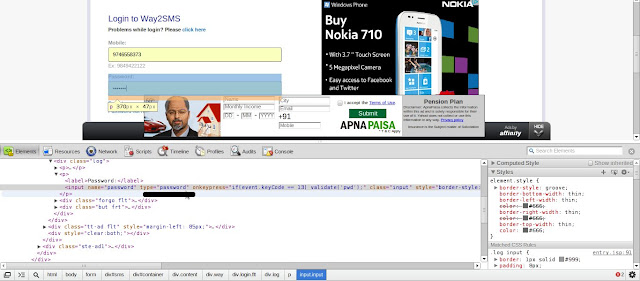
Remove the mask of passwords in any browser

If we use autofill settings there is a chance to forgot the password , your browser will always block the password box from passersby seeing it by using asterisks. To remove the mask and reveal your password, you just need to do a few things.


Follow the steps:


1. Right-click the password box and select "Inspect Element."This brings up the developer console

2.. On the line that starts with "input type=password

3. Right click and select Edit HTML

4. change the word "password" to "text" ( type="password"  to type="text")


InSecure ANDROID Smartphones

SharkLaser writes

"Fake antivirus scams have plagued Windows and Mac OS X during the last couple of years. Now it seems like such scams have spread to Android. Fake antivirus scams on Android work the same as they do on PC's — a user with an Android phone downloads an application or visits a website that says that the user's device is infected with malware. It will then show a fake scan of the system and return hard-coded 'positives' and gives the option the option to buy antivirus software that will 'remove' the malware on the affected system. Android, which is based on Linux, has been plagued with malware earlier too. According to McAfee, almost all new mobile malware now targets Android. Android app stores, including the official one from Google, has also been hosting hundreds of trojan applications that send premium rate SMSes on behalf of unsuspecting users.


Early on in development, the core Android development team recognized that a robust security model was required to enable a vigorous ecosystem of applications and devices built on and around the Android platform and supported by cloud services. As a result, through its entire development lifecycle, Android has been subjected to a professional security program. The Android team has had the opportunity to observe how other mobile, desktop, and server platforms prevented and reacted to security issues and built a security program to address weak points observed in other offerings.
The key components of the Android Security Program include:
  • Design Review: The Android security process begins early in the development lifecycle with the creation of a rich and configurable security model and design. Each major feature of the platform is reviewed by engineering and security resources, with appropriate security controls integrated into the architecture of the system.
  • Penetration Testing and Code Review: During the development of the platform, Android-created and open-source components are subject to vigorous security reviews. These reviews are performed by the Android Security Team, Google’s Information Security Engineering team, and independent security consultants. The goal of these reviews is to identify weaknesses and possible vulnerabilities well before the platform is open-sourced, and to simulate the types of analysis that will be performed by external security experts upon release.
  • Open Source and Community Review: The Android Open Source Project enables broad security review by any interested party. Android also uses open source technologies that have undergone significant external security review, such as the Linux kernel. Google Play provides a forum for users and companies to provide information about specific applications directly to users.
  • Incident Response: Even with all of these precautions, security issues may occur after shipping, which is why the Android project has created a comprehensive security response process. A full-time Android security team constantly monitors Android-specific and the general security community for discussion of potential vulnerabilities. Upon the discovery of legitimate issues, the Android team has a response process that enables the rapid mitigation of vulnerabilities to ensure that potential risk to all Android users is minimized. These cloud-supported responses can include updating the Android platform (over-the-air updates), removing applications from Google Play, and removing applications from devices in the field.


    How Users Understand Third-Party Applications

    Android strives to make it clear to users when they are interacting with third-party applications and inform the user of the capabilities those applications have. Prior to installation of any application, the user is shown a clear message about the different permissions the application is requesting. After install, the user is not prompted again to confirm any permissions.
    There are many reasons to show permissions immediately prior to installation time. This is when user is actively reviewing information about the application, developer, and functionality to determine whether it matches their needs and expectations. It is also important that they have not yet established a mental or financial commitment to the app, and can easily compare the application to other alternative applications.
    Some other platforms use a different approach to user notification, requesting permission at the start of each session or while applications are in use. The vision of Android is to have users switching seamlessly between applications at will. Providing confirmations each time would slow down the user and prevent Android from delivering a great user experience. Having the user review permissions at install time gives the user the option to not install the application if they feel uncomfortable.
    Also, many user interface studies have shown that over-prompting the user causes the user to start saying "OK" to any dialog that is shown. One of Android's security goals is to effectively convey important security information to the user, which cannot be done using dialogs that the user will be trained to ignore. By presenting the important information once, and only when it is important, the user is more likely to think about what they are agreeing to.

    Some platforms choose not to show any information at all about application functionality. That approach prevents users from easily understanding and discussing application capabilities. While it is not possible for all users to always make fully informed decisions, the Android permissions model makes information about applications easily accessible to a wide range of users. For example, unexpected permissions requests can prompt more sophisticated users to ask critical questions about application functionality and share their concerns in places such as Google Play where they are visible to all users.
 

ElcomSoft:one-touch WiFi cracking system


It's been a few years since we checked in with Elcomsoft's Wireless Security Auditor WiFi cracking software. As you'd expect, things have become easier, much easier. Elcomsoft now has an all-in-one solution that will locate wireless networks, intercept data packets, and crack WAP/WPA2 PSK passwords from any modern laptop with a discrete ATI AMD or NVIDIA graphics card. Here's the quote IT nerds will surely we love:
Today, ElcomSoft is integrating a wireless sniffer into Elcomsoft Wireless Security Auditor. The integrated sniffer turns Elcomsoft Wireless Security Auditor into a one-button, all-in-one solution ready to be used by corporate security officers without specific experience in information security.
Call us crazy, but if you're a C-level security officer with no specific information security experience then maybe you shouldn't be sniffing people's data packets. Then again, we're sure ElcomSoft will happily sell their $1,199 pro software or $399 standard edition to any hacker willing to pay, white hat or not.


ElcomSoft Releases an All-in-One Wi-Fi Cracking Solution


MOSCOW, September 23, 2010 -- ElcomSoft Co. Ltd. upgrades Wireless Security Auditor, a wireless key recovery solution for Wi-Fi networks, to being a true all-in-one wireless cracking solution. Elcomsoft Wireless Security Auditor can automatically locate wireless networks, intercept data packets, and crack WPA/WPA2 PSK passwords. Adding the support of AirPCap family Wi-Fi adapters, ElcomSoft Wi-Fi password recovery tool turns any modern laptop with discrete graphics into a mobile wireless security audit system, and provides mobile forensic and law enforcement units with access to protected wireless networks.

Background

The original version of Elcomsoft Wireless Security Auditor enabled network administrators to perform timed attacks on their wireless networks in order to determine how secure exactly their networks were. In order to operate, it required ready-made dumps or wireless traffic. The dumps could be made with a third-party "sniffer" running under Linux or Windows. The requirement to use a third-party product limited the capabilities and ease of use of Elcomsoft Wireless Security Auditor.

Integrated Wi-Fi Sniffer

Today, ElcomSoft is integrating a wireless sniffer into Elcomsoft Wireless Security Auditor. The integrated sniffer turns Elcomsoft Wireless Security Auditor into a one-button, all-in-one solution ready to be used by corporate security officers without specific experience in information security.

The integrated sniffer is utterly convenient. Displaying all available wireless networks complete with channel numbers, MAC-addresses, SSID, speed, load and encryption parameters, the sniffer connects to a selected Wi-Fi network, and logs wireless traffic complete with "handshake" packets required to starts the password recovery attack.

Laptop-Based Wireless Security Audit

The new built-in sniffer requires the use of a dedicated Wi-Fi adapter, and supports AirPcap family of hot-pluggable wireless USB adapters. By supporting AirPcap wireless USB adapters and including the new sniffer in the package, ElcomSoft makes it possible to turn any modern laptop (*) into a high-end wireless security audit system.

(*) Laptops with ATI or NVIDIA discrete graphics are recommended to enable ElcomSoft GPU acceleration.

About Elcomsoft Wireless Security Auditor

Elcomsoft Wireless Security Auditor helps system administrators and corporate security officers to audit wireless network security. The suite attempts to recover the original plain-text password protecting Wi-Fi communications via WPA/WPA2 PSK protocols for a certain time period, ensuring or disclaiming network resistibility against the most advanced attacks.

Considering the increased security requirements found in WPA/WPA2 protected networks, Elcomsoft Wireless Security Auditor employs the highest-performance dictionary-attack with advanced mutations to allow carrying out a password audit within a limited timeframe.

The wireless cracking tool employs ElcomSoft GPU acceleration technologies, using the massively parallel GPU units of modern ATI and NVIDIA graphic accelerators to perform computational-intensive calculations. By employing GPU acceleration, Elcomsoft Wireless Security Auditor becomes one of the fastest and most cost-efficient Wi-Fi password recovery and wireless security audit tools on the market.

About AirPcap Product Family

Manufactured by CACE Technologies Inc., the AirPcap family of hot-pluggable wireless USB adapters is the first open, affordable and easy-to-deploy Windows-based packet capture solution for Wi-Fi networks. Supporting 802.11 a/b/g/n protocols, AirPcap captures full 802.11 data complete with management and control frames. The use of an AirPcap adapter provides developers with wireless traffic collection and in-depth analysis capabilities.

About ElcomSoft Co. Ltd.

Founded in 1990, ElcomSoft Co. Ltd. develops state-of-the-art computer forensics tools, provides computer forensics training and computer evidence consulting services. Since 1997, ElcomSoft has been providing support to businesses, law enforcement, military, and intelligence agencies. ElcomSoft tools are used by most of the Fortune 500 corporations, multiple branches of the military all over the world, foreign governments, and all major accounting firms. ElcomSoft and its officers are members of the Russian Cryptology Association. ElcomSoft is a Microsoft Certified Partner and an Intel Software Partner.

Elcomsoft Wireless Security Auditor supports Windows NT4, 2000, XP, Vista, and Windows 7, as well as Windows 2003 and 2008 Server. Elcomsoft Wireless Security Auditor Pro is available to North American customers for $1199. The Standard edition is available for $399. Local pricing varies. For more information visit http://www.elcomsoft.com/ewsa.html

AirPcap is a copyright of CACE Technologies Inc.

ElcomSoft Co. Ltd.

http://www.elcomsoft.com/

SOURCE Elcomsoft Co.Ltd.
 

To Learn How To Hack Like A Pro


Whether you’re a college student, a middle-aged networking guru or a wife and mother fascinated by the world of online games – everyone occasionally comes across a situation where some form of hacking would make life a whole lot easier.
Maybe you’ve lost the license that came with your legitimate software package that you paid for. Maybe you want to make a backup copy of your favorite DVD movie, but there’s copy-protection encoded onto the disk. Or maybe you’re just stuck on a popular online game and you want to know if there are any hacks available to level up in the game without the required effort.
Whatever your specific needs or situation – I’m not here to judge. In the field of computers and Internet technologies, just about everything is written in one programming language or another. No programmer is perfect – they all make mistakes. There are back doors, secret codes and vulnerabilities in just about any application you come across. Because of that, if you learn how to hack on your own, or just following the efforts of active hacking communities can provide you with tremendous eye-opening insight into the inner-workings of even your most “trusted” software applications.

Where You Can Go To Learn How To Hack Like a Pro

One thing that’s obvious when you visit the websites where professional hackers hang out – there’s so much about programming that even the most seasoned professional programmers don’t know. Professional hackers are an exceptional, amazing and terrible breed of individuals all packaged into one. While I write this, I realize that I am also describing over half of our readership – you know who you are! These folks take programming to an extreme that’s simply astounding when you see it in action.
While many of us write applications using all of the standard techniques that you learn in programming classes in college, these folks take programming into a realm where there are no rules. They can test all aspects of an application until they find a chink in the armor, and then exploit those vulnerabilities.
As we explore the world of hacking, it should be noted that there are two major forms of hacking – we’ll call it “white hat” and “black hat.” The “white hat” hackers call themselves “ethical hackers,” in that they find vulnerabilities and exploits only to make the programming and application communities more secure for everyone. However, there’s a whole othercommunity of hackers who find vulnerabilities to do nothing more than exploit them as much as humanly possible. Now that you know what sort of community you may be entering, let’s get on with the list of top sites where you can learn how to hack.

#1 – CyberXtreme: Hacking and Warez

CyberXtreme is an impressive forum with a significant hacking section, but also entire sections on technology, graphics and even a tech support area. Here you’ll find cracks, secret codes, free download packages (some containing cracked software which may be illegal to download in your area, so be careful). The forum is very protective of its content, so you’ll have to register with a valid email address before you can even get a glimpse of the content that’s on the forums.


#2 – EvilZone Hacking Forums

While the name, EvilZone, isn’t exactly the most inviting – it is easily one of the largest forum communities that you’ll find on the subject of hacking. With over 6,500 members and over 100,000 posts (and counting), this community likely has the skills and knowledge to answer any programming question you could possibly have. Just be careful about coming across as a “noob” – these guys don’t handle newcomers with kid gloves, so be careful.

#3 – Hack a Day

While I certainly don’t want to offer a nod to any blogs that may be considered competition, you really have to give credit where credit is due when it comes to a particular niche like hacking – and Hack a Day definitely offers an amazing library of information for anyone looking for specific categories like cellphones, GPS or digital cameras. You’ll find all hacks organized by category in the right column.

#4 – Hack In The Box

If any site could be classified as the most comprehensive site to learn how to hack, this would be it. Hack In The Box is more about security and ethical hacking than anything else – and that’s more than obvious reviewing the classes and conferences listed on the main page.

#5 – Hack This Site!

As always, saving the best for last – I’d like to introduce Hack This Site! This website is one of the coolest, free programmer training sites where you can learn how to hack accepting one of the challenges.


New Hacker Ethic


From my documents, I found that there is a new hacker ethic which 90s hackers live by. There are fragments of continuity from the old hacker ethic, as one can see. The new ethic appears to have developed like the old one, informally and by processes of mutual reinforcement. The new ethic seems to contain some ambiguities (like the old one) and a few contradictions. This may be due to the fact that its practicioners are more numerous and more dispersed than the original 60s hackers.
  1. "Above all else, do no harm" Do not damage computers or data if at all possible. Much like the key element of the Hippocratic Oath.
    According to the "hacker ethic," a hack must: * be safe
    * not damage anything
    * not damage anyone, either physically, mentally or emotionally
    * be funny, at least to most of the people who experience it

    [8]


    It is against hacker ethics to alter any data aside from the logs that are needed to clean their tracks. They have no need or desire to destroy data as the malicious crackers. They are there to explore the system and learn more. The hacker has a constant yearning and thirst for knowledge that increases in intensity as their journey progresses.[9]


    2. The belief that system-cracking for fun and exploration is ethically OK as long as the cracker commits no theft, vandalism, or breach of confidentiality.[10]
    Of course, the key problem with this ethical position is its stance on intent. One should not damage data deliberately. But what if, as often happens in hacking attempts, one accidentally erases or alters data while trying to alter system log files or user records? Is that an ethical violation? Also, the question of what constitutes "harm" is left open. Most hackers seem to see pranks and practical jokes as harmless, regardless of their psychological impact. Yet their victims may not feel these are so 'harmless,' especially if this causes them to lose valuable time or effort.
  2. Protect Privacy People have a right to privacy, which means control over their own personal (or even familial) information. Privacy rights are notably missing from the U.S. Constitution, but they have been brought to the forefront of modern legal argument due to the growing surveillance power of technology. There still is no codified right to privacy for U.S. citizens, although the Supreme Court has ruled that it is contained implicitly in its judgements legalizing the distribution of birth control and the right to first-trimester abortion.How far do privacy rights go, however? Do people also have an intrinsic right to online anonymity? Do I have the right to conceal my health status, criminal record, or sexuality from my employer? Are some people (politicians, celebrities, etc.) entitled to less privacy than others? Does my social security number, credit history, or telephone number belong only to me? Further, the strange thing about hackers asserting a right to privacy is that it declares a certain kind of information to not be free. Thus, in some ways this is a contradiction to the original hacker ethic.

    Your right to Privacy
    Privacy is a right we beleive we have. Unfortunately privacy is not explicitately protected in the constitution. Our consitution is dated in that respect, there weren't the threats to privacy then as there are now. Technology is truly a double-edged sword. The abscense of privacy provisions in the constitution does not make it any less important. Indeed, the lack of constitutional protections have allowed our privacy to be gravely threatened.[11]


    The concept of privacy is something that is very important to a hacker. This is so because hackers know how fragile privacy is in today's world. Wherever possible we encourage people to protect their directories, encrypt their electronic mail, not use cellular phones, and whatever else it takes to keep their lives to themselves. In 1984 hackers were instrumental in showing the world how TRW kept credit files on millions of Americans. Most people had never even heard of a credit file until this happened. Passwords were very poorly guarded - in fact, credit reports had the password printed on the credit report itself.[12]
    The second argument is an interesting one. The problem most hackers had with TRW is not they kept files on most peoples' credit histories without their knowledge (thus they couldn't see if they contained any errors), and it was on that (unknown) basis that they were denied loans, credit cards, mortgages, etc. It was that those files were insecure.
  3. "Waste not, want not." Computer resources should not lie idle and wasted. It's ethically wrong to keep people out of systems when they could be using them during idle time. This is what some people call the "joy riders' ethic." If you borrow someone's car, and return it with no damage, a full tank of gas, and perhaps even some suggestions for improved performance, have you not done them a favor? Especially if they never know you borrowed it in the first place for a few road trips? Isn't it wasting that precious engine power to leave the car in a parking spot while somebody else could be using it for a grocery trip? (Is it an ethical violation to borrow the car and make a set of keys for yourself so you can borrow it whenever you feel like? This is, after all, what most hackers do when they give themselves sysadmin privileges.) Yet most are possessive over the use of their own personal computer.
    The hacker ethics involves several things. One of these is avoiding waste. Over the internet, we have about a quarter million computers each of which is virtually unused for 10 hours a day. A true hacker seeing something useful that he could do with terraflops of computing power that would otherwise be wasted might would request permission to use these machines and would probably go ahead and use them even if permission was denied. In doing so, he would take the greatest possible precautions to not damage the system.[13]
  4. Exceed Limitations Hacking is about the continual transcendence of problem limitations. Some old hackers assert this principle, as an informal seventh addition to the original Ethic. Telling a hacker something can't be done, is a moral imperative for him to try. "Extropians" believe there is a universal force of expansion and growth, inverse to entropy, which they call "extropy." Hacking is seen as extropian because it always seeks to surpass current limits. Technology is seen as a necessarily exponential force of growth. Limitations must be overcome. For some hackers, these limitations might be unjust laws or outdated moral codes.
    To become free it may be necessary to break free from medieval morality, break unjust laws, and be a disloyal employee. Some may call you an disloyal, sinful criminal. To be free in a room of slaves is demoralizing. Free your fellow man, give him the tools, the knowledge to fight oppression. Do not infringe on others' rights.[14]
  5. The Communicational Imperative People have the right to communicate and associate with their peers freely. The United Nations International Telecommunications Union (ITU) has stated in many conferences that this should be a fundamental human right, with which no nation should ever interfere. The sweeping freedoms given to amateur radio hobbyists internationally reflect this belief. Globally, it remains a significant moral problem, in that most developing nations lack the infrastructure to grant this right. Various UN reports have shown that despite the rhetoric, many Third World nations do not have access to the "global" information superhighway because they lack "onramps." Their telecommunications infrastructure is lacking.Most hackers strongly support the 1st amendments' rights to communication and assembly, since these are necessary for the free flow of information. Phreakers take this a step beyond, however, in asserting that people should have the right to communicate with each other cheaply (thus poor people have as much right to talk on the phone long distance as the rest of us) and easily . When telecommunications companies are an obstacle to this right to communicate, phreaking (blue boxing the phone system, making unauthorized 'bridge' conference calls, using empty voicemail boxes, etc.) is said to be the answer.

    The Right to communicate
    Communicate!
    This is our strongest right, and our most crucial. There mere fact that this page is allowed to exist is proof that our 1st amendment has not crumbled completely. Despite the governmental protection, there are threats to our freedom to communicate.
    [15]
  6. Leave No Traces Don't leave a trail or trace of your presence; don't call attention to yourself or your exploits. Keep quiet, so everyone can enjoy what you have. This is an ethical principle, in that the hacker follows it not only for his own self-interest, but also to protect other hackers from being caught or losing access. Such a principle can be found among various criminal or underground organizations. Of course, there is a contradiction between asserting a need for secrecy (as well as privacy), and the need for unrestricted information.
    The rules a Hacker lives by:
    1. Keep a low profile.
    2. If suspected, keep a lower profile.
    3. If accused, deny it.
    4. If caught, plea the 5th.
    [16]
  7. Share! Information increases in value by sharing it with the maximum number of people; don't hoard, don't hide. Just because it wants to be free, does not mean necessarily you must give it to as many people as possible. This principle can be seen as an elaboration on an original ethical principle. The Pirates' ethic is that piracy increases interest in software, by giving people a chance to try it out and experiment with it before paying for it. So sharing software with your friends is a good thing.
    Pirates SHARE warez to learn, trade information, and have fun! But, being a pirate is more than swapping warez. It's a life style and a passion. The office worker or class mate who brings in a disk with a few files is not necessarily a pirate any more than a friend laying a copy of the lastest Depeche Mode album on you is a pirate. The *TRUE* pirate is plugged into a larger group of people who share similar interests in warez. This is usually done through Bulletin Board Systems (BBSs), and the rule of thumb is "you gotta give a little to get a little...ya gets back what ya gives." Pirates are NOT freeloaders, and only lamerz think they get something for nothing.[17]
  8. Self Defense against a Cyberpunk Future Hacking and viruses are necessary to protect people from a possible 1984/cyberpunk dystopian future, or even in the present from the growing power of government and corporations. It's a moral imperative to use hacking as the equivalent of 'jujitsu,' allowing the individual to overcome larger, more impersonal, more powerful forces that can control their lives. If governments and corporations know they can be hacked, then they will not overstep their power to afflict the citizenry.
    I believe, before it's all over, that the War between those who love liberty and the control freaks who have been waiting for to rid America of all that constitutional mollycoddling called the Bill of Rights, will escalate.Should that come to pass, I will want to use every available method to vex and confuse the eyes and ears of surveillance. Viruses could become the necessary defense against a government that fears your computer.[18]
    What's interesting is that this principle recognizes and asserts that it's not only possible but also likely for computers to have a dark side and to be used for purposes other than truth and beauty, and that we need to be wary of technology, or at least technology in the wrong hands.
  9. Hacking Helps Security This could be called the "Tiger team ethic": it is useful and courteous to find security holes, and then tell people how to fix them. Hacking is a positive force, because it shows people how to mend weak security, or in some cases to recognize and accept that total security is unattainable, without drastic sacrifice.
    Sense 2 is more controversial: some people consider the act of cracking itself to be unethical, like breaking and entering. But the belief that `ethical' cracking excludes destruction at least moderates the behavior of people who see themselves as `benign' crackers (see also samurai). Based on this view, it may be one of the highest forms of hackerly courtesy to (a) break into a system, and then (b) explain to the sysop, preferably by email from a superuser account, exactly how it was done and how the hole can be plugged --- acting as an unpaid (and unsolicited) tiger team.[19]
    Many software companies today, including Lotus, regularly use tiger teams to test their security systems. So, this ethical principle seems to be agreed upon by some members of the industry -- to a certain extent. Even Lotus does not want its systems being tested by hackers who are not under its employ or control.
  10. Trust, but Test! You must constantly test the integrity of systems and find ways to improve them. Do not leave their maintenance and schematics to others; understand fully the systems you use or which affect you. If you can exploit certain systems (such as the telephone network) in ways that their creators never intended or anticipated, that's all to the better. This could help them create better systems. One of those systems that may require constant revision, testing, and adjustment, apparently, is constitutional democracy.
    Democracy is always being tested -- it's an inherent part of what it stands for. whether it's flag burners, gay activists, klansmen, or computer hackers, we're always testing the system to see if it holds up to pressure. i stress that this is NOT an end iwe do because it interests us, but in the bigger picture we're actually testing the sincerity of the democratic system, whether we're aware of it or not.[20]
    One of the most important manuals for British hackers was called "beating the system." The essential argument is that as systems (like the phone network) become more and more complex, they become impossible to manage from a centralized office. Hacking at the edges of the system not only becomes possible, in some cases it becomes necessary. It becomes an ethical imperative to test the system, lest it fail when it is most needed (like the AT & T phone switches did in 1990.)
So, in short, the new hacker ethic suggests that it is the ethical duty of new hackers (or the CU), to : 1) protect data and hardware 2) respect and protect privacy 3) utilize what is being wasted by others 4) exceed unnecessary restrictions 5) promote peoples' right to communicate 6) leave no traces 7) share data and software 8) be vigilant against cyber-tyranny and 9) test security and system integrity of computer systems.

Violations/Transgressions

These could be considered the "thou shalt nots" of the new hacker ethic, as opposed to its affirmative "you shoulds." Some of these transgressions of the hacker ethic are already implied by some of its basic affirmative principles. We can get an idea of what hackers believe they should do, based on what they reject as unsuitable activities of their peers.
  1. Bootlegging Commercialism; selling pirated software; hacking for profit; selling out. Bootlegging violates the new ethic of sharing and the original hacker ethic which eschewed profit (and embraced personal satisfaction) as a reason for creating software (hence the existence of Richard Stallman's GNU Free Software Foundation.)
    On occasion the possibility of making a profit from these advances tempts hackers into commercialism. On other occasions, they see commercialism as the only way to get their work into the hands of the masses. When they succeed they become rich, and usually get moved further and further from hacker life and more and more into paperwork and then don't live happily ever after.[21]


    Bootleggers are to pirates as a chop-shop is to a home auto mechanic. Bootleggers are people who DEAL stolen merchandise for personal gain. Bootleggers are crooks. They sell stolen goods. Pirates are not crooks, and most pirates consider bootleggers to be lower life forms than child molesters.[22]
    Bootlegging seems to contradict new hacker ethic 7, share!
  2. Freeloading Always taking and never contributing. Profitting from other peoples' efforts without adding to them. "Warez d00dz" and "Codez d00dz" who are hunting for free software or phone codes without offering anything in return (a hack, a number, whatever) are looked down upon. Hoarding and refusing to tell others about your hacks are seen as wrong. This also violates the new ethic of sharing.
    In fact, pirates may be one of the best forms of advertising for quality products, because sharing allows a shop-around method for buying warez. Most of us buy a program for the documents and the support, but why invest in four or five similar programs if we aren't sure which best suits our needs? Nah, pirates aren't freeloaders. We are against freeloading.[23]
  3. Trashing Crashing systems; destroying hardware; hurting other users; malicious vandalism; irreversible damaging or destroying of data; unleashing destructive viruses, Trojans, logic bombs. Prankful (non-harmless) games with users and sysops and systems is acceptable... This is seen as the obvious corollary of the new ethic to "do no harm."
    I. Do not intentionally damage *any* system. Trashing BBSes is wrong, plain and simple.
    II. Do not alter any system files other than ones needed to ensure your escape from detection and your future access (Trojan Horses, Altering Logs, and the like are all necessary to your survival for as long as possible.)
    [24]


    The one thing I hate, is the way some self-appointed hackers find there way into a system, and ruin the name of the rest of us by destroying everything they can find. Now that is pathetic. First of all, as I said, it ruins the name of the rest of us. Thus, once again, the "Destructive Computer User" Stereotype... A board crasher is no more a "hacker" than my grandmother is.[25]
  4. Excessive Selfishness Self interest overrules any concern for other hackers whatsoever. This violation implies others... once again, we run into the strange divide at the heart of the Hacker Ethic, which is deeply individualistic, yet also fiercely communal. Individuals are expected to be highly self-motivated, but not selfish.
    I think you'd be less agitated if you define your categories as hackers and criminals. The former are in it to explore and the latter are in it for themselves and nothing else. Of course, some hackers do break laws on occasion but I don't think that necessarily turns them into criminals, at least not in the moral sense.[26]


    Also, some hackers have this massive ego problem... I must name one here, for that problem, and he is Corporal Punishment... I have had numerous run-ins with this guy. He seems to think he is a God, constantly running everyone into the ground. He even went as far as saying "PHRACK sucks!" But he isn't the only one with that problem... Some feel that if they put others down, they will elevate to a higher level. Sorry to burst you bubble guys, but your only viewed as massive ego-maniacs that deserve nothing less than being run down yourselves...[27]


    Let us not forget that hackers, crackers, chippers, crunchers, and whatnot all have ego, and one thing that bothers me about using the Hacker Ethic to describe people is that ego and self-interest are not accounted for. How else can you explain crackers selling pirated software, otherwise intelligent people distributing viruses to the general public in hope of causing maximum damage to other users, or hackers breaking into some system and erasing files for laughs? People break into computers because it's fun and it makes one feel powerful, not because there is untapped power waiting to be used if only the right programming "wizard" comes along.[28]
  5. The (Selective) Anti-Stealing Ethic Information, services, and software are not property; hardware, physical property, money, and monetary services (credit cards, digital cash, phone card numbers) are. Theft of these is still wrong. Also, the target makes a difference. Stealing phone service (say, voicemail boxes) from a large institution like a corporation or the government is OK. Stealing it from an individual or a small nonprofit is not.Thus the new hacker ethic, according to its propagandists, does not embrace theft; instead it simply defines certain things (like information) as not being personal property, or certain actions (using phone service) as "borrowing" rather than theft.

    So where is the boundary between the hacker world and the criminal world? To me, it has always been in the same place. We know that it's wrong to steal tangible objects. We know that it's wrong to vandalize. We know that it's wrong to invade somebody's privacy. Not one of these elements is part of the hacker world.[29]
  6. Bragging Calling too much attention to oneself. It is acceptable ('elite') to brag in private hacker circles, unacceptable to brag or make taunts and dares to sysops, law enforcement, or authorities, or in any public forum where they tend to listen. Some hackers even consider the first unacceptable, since hacker boards are monitored by the Secret Service as well. Bragging and boasting to the media or other non-hackers violates the ethic of 'leave no trace' and keeping a low profile.
    Bragging after a neat hack may seem like the natural thing to do. But just remember that it can only call attention to yourself, and not everyone who pays attention to hackers are admirers. You may jeopardize your friends and anyone else who ever accesses the same system as you.[30]


    True hackers are quiet. I don't mean they talk at about .5 dB, I mean they keep their mouths shut and don't brag. The number one killer of those the media would have us call hackers is bragging. You tell a friend, or you run your mouth on a board, and sooner or later people in power will find out what you did, who you are, and you're gone...[31]
  7. Spying Snooping, monitoring of people, and invading their privacy is wrong... so therefore is reading private e-mail, etc. This follows from the new hacker ethic which sees privacy as a fundamental right. However, part of the hacker praxis is about finding out passwords and security holes from users, whether through "social engineering" or simple snooping and "sniffing." This is the contradiction, once again, of embracing privacy but also insisting on unrestricted information.
    Some crackers are using computers in the exact *opposite* way that the first hackers intended them: first, by restricting the unimpeded and unmonitored flow of information through the computer networks and phone lines; and second, by using computers to monitor people, by intrusive methods of information-gathering.[32]
  8. Narcing It is wrong to turn other hackers in. This part of their ethical code is not different from many other criminal organizations or subcultures, such as prison inmates, drug addicts, prostitutes, etc., or even 'above-ground' subcultures such as police departments. ("code of silence.") However, this code has special meaning for hackers, since many ex-hackers often decide to become computer security personnel later in life. Many of their peers consider this 'selling out.'
    There's no lower form of life than the narc. Hackers who go and rat on other hackers are scum. They get lots of promises of immunity and stuff if they turn in all their friends. Some hackers get back at other people by turning them into the feds. This is wrong, and it only damages the hacker community. We need to stick together, because nobody else is really on our side.[33]


    The last thing I will mention, will be hackers turning in other hackers to federal crime agencies, or to the PhoneCorp security offices, or any other type of company that deals with computer related phraud. This activity, refered to as Narcing, is getting to be too popular for a hackers good... You may be saying, " Come on, no hacker in they're right mind would turn another on in ". And your right... It's once again those self proclaimed hackers, or the ones who think they are who will do this to get "Even"...[34]
We can then see that new hackers do believe certain things are wrong - and people who commit these actions are frowned upon and often prevented from being recognized by the hacker community. Many of the things new hackers reject, would also be rejected by the community of old hackers.


Social engineering ; A career


social engineering is method of retrieving password or answer of security question simply be quering with the victim. You have to be very careful while using this as victim must not be aware of your intention. Just ask him cautiously using your logic.

When most people hear "Social Engineering," they think of the criminal aspects of the term. But the practice also has professional applications for security practitioners who want to help test and improve organizations' security practices.
Being able to determine which type of job you are seeking is crucial. In-house and contract employees have different challenges.. Recent contract wins and any enforcement action should be noted, as well as awards and recognition for outstanding work and employee satisfaction. Purchases and sales of smaller companies are a good indicator of business growth opportunities, as well as knowledge about skills important to the company.
In order to gain internal information about the company, try to get personal interaction with employees of your target. Human Resources departments sometimes hold job fairs or community outreach allowing you to get more information about the employees and their opinions. Research into newsgroups and mailing lists can turn up topics of interest to the company. Knowledge of regulatory environments for the company's customers is critical for interview stages.


This sounds to be pretty not working at beginning. Even I was neglecting this way. But, once, I thought of using it against my friend on Facebook and i got his Facebook password very easily by this method. I think many of you might be knowing how what this social engineering, For newbies, 

Social engineering undoubtedly is an integral aspect of information security and is a growing, respectable career field for professionals who value information security awareness and wish to play an active role in protecting security controls that govern the processes, operations, and transactions of any organization and add a distinct value within the institutional culture that informs and influences employee behavior. Social engineers are hired on both contract and permanent basis by independent IT/ Security consulting companies and government agencies to target client organizations in order to identify vulnerabilities that could cause important information to be compromised from their respective networks and system and thereby provide them with guidelines and recommendations to prevent this security threat.


  • Researching for rewards


  • Use Public Relations and Human Resource departments to gain personal interaction with employees.


  • Job fairs and outreach programs are a good way to gain face time with the target company.


  • Internships are a great way in for candidates recently out of educational work.
    Making the contacts


  • Blend in for personal interaction, and be flexible with your responses.


  • Try to keep talking at a higher level; don't overload the person with all your skills.


  • Find out background information, such as compliance or regulatory environments.


  • Be aware of contractual issues within a particular job or industry.
  •  

    Facebook Privacy : keep Your Account Protected

    1. Your name, your profile picture, your gender, your current city, the networks you’re in, who you’re friends with, and the pages you’re a fan of are available to anyone. These are known as publicly accessible information (PAI). You have no control over this.
    2. Any other piece of content marked visible to “Everyone” in your privacy settings is available to anyone. You have control over this.
    3. Any Facebook application or web site using Facebook Connect that you visit can access your PAI and content marked visible to “Everyone” in your privacy settings. You have no control over this.
    4. Any Facebook application you log in to or web site that you connect with your Facebook account can access all of your profile information (except for contact information), photos, videos, notes, events, groups, links, and notifications, regardless of your privacy settings. You have no control over this.
    5. Any Facebook application your friends log in to or web site your friends connect with their Facebook account that you have not also logged in to or connected with can access your information and content based on your application, profile, and content privacy settings. You have control over this.
    6. Any wall post a Facebook application or web site using Facebook Connect makes on your profile is visible to anyone who can view your wall. You have no control over this.
    7. Any change to profile information or feedback on content will generate a story on your wall visible to anyone who can also access the information or content. You have no control over this.
    8. Profile information, photos, videos, and notes are visible to other users based on your profile and content privacy settings. You have control over this.
    9. Events you’re invited to are visible to other users who can also view the event. You have no control over this.
    10. Past status updates and links are visible to other users based on the privacy setting used when posted. You have no control over this.
     

    Essential Network Security Tools for Hacking

      Wireshark

    Wireshark logo Wireshark (known as Ethereal until a trademark dispute in Summer 2006) is a fantastic open source multi-platform network protocol analyzer. It allows you to examine data from a live network or from a capture file on disk. You can interactively browse the capture data, delving down into just the level of packet detail you need. Wireshark has several powerful features, including a rich display filter language and the ability to view the reconstructed stream of a TCP session. It also supports hundreds of protocols and media types. A tcpdump-like console version named tshark is included. One word of caution is that Wireshark has suffered from dozens of remotely exploitable security holes, so stay up-to-date and be wary of running it on untrusted or hostile networks (such as security conferences).

      Metasploit

    Metasploit logo Metasploit took the security world by storm when it was released in 2004. It is an advanced open-source platform for developing, testing, and using exploit code. The extensible model through which payloads, encoders, no-op generators, and exploits can be integrated has made it possible to use the Metasploit Framework as an outlet for cutting-edge exploitation research. It ships with hundreds of exploits, as you can see in their list of modules. This makes writing your own exploits easier, and it certainly beats scouring the darkest corners of the Internet for illicit shellcode of dubious quality.
    Metasploit was completely free, but the project was acquired by Rapid7 in 2009 and it soon sprouted commercial variants. The Framework itself is still free and open source, but they now also offer a free-but-limited Community edition, a more advanced Express edition ($3,000 per year per user), and a full-featured Pro edition ($15,000 per user per year). Other paid exploitation tools to consider are Core Impact (more expensive) and Canvas (less).
    The Metasploit Framework now includes an official Java-based GUI and also Raphael Mudge's excellent Armitage. The Community, Express, and Pro editions have web-based GUIs.

    Nessus

    Nessus logo Nessus is one of the most popular and capable vulnerability scanners, particularly for UNIX systems. It was initially free and open source, but they closed the source code in 2005 and removed the free "Registered Feed" version in 2008. It now costs $1,200 per year, which still beats many of its competitors. A free “Home Feed” is also available, though it is limited and only licensed for home network use.
    Nessus is constantly updated, with more than 46,000 plugins. Key features include remote and local (authenticated) security checks, a client/server architecture with a web-based interface, and an embedded scripting language for writing your own plugins or understanding the existing ones. The open-source version of Nessus was forked by a group of users who still develop it under the OpenVAS name

    Aircrack

    Aircrack is a suite of tools for 802.11a/b/g WEP and WPA cracking. It implements the best known cracking algorithms to recover wireless keys once enough encrypted packets have been gathered. . The suite comprises over a dozen discrete tools, including airodump (an 802.11 packet capture program), aireplay (an 802.11 packet injection program), aircrack (static WEP and WPA-PSK cracking), and airdecap (decrypts WEP/WPA capture files).

    Snort

    Snort logo This network intrusion detection and prevention system excels at traffic analysis and packet logging on IP networks. Through protocol analysis, content searching, and various pre-processors, Snort detects thousands of worms, vulnerability exploit attempts, port scans, and other suspicious behavior. Snort uses a flexible rule-based language to describe traffic that it should collect or pass, and a modular detection engine. Also check out the free Basic Analysis and Security Engine (BASE), a web interface for analyzing Snort alerts.
    While Snort itself is free and open source, parent company SourceFire offers their VRT-certified rules for $499 per sensor per year and a complementary product line of software and appliances with more enterprise-level features. Sourcefire also offers a free 30-day delayed feed

      Cain and Abel

    UNIX users often smugly assert that the best free security tools support their platform first, and Windows ports are often an afterthought. They are usually right, but Cain & Abel is a glaring exception. This Windows-only password recovery tool handles an enormous variety of tasks. It can recover passwords by sniffing the network, cracking encrypted passwords using dictionary, brute-force and cryptanalysis attacks, recording VoIP conversations, decoding scrambled passwords, revealing password boxes, uncovering cached passwords and analyzing routing protocols

    BackTrack
    This excellent bootable live CD Linux distribution comes from the merger of Whax and Auditor. It boasts a huge variety of Security and Forensics tools and provides a rich development environment. User modularity is emphasized so the distribution can be easily customized by the user to include personal scripts, additional tools, customized kernels, etc.


     NETCAT
    This simple utility reads and writes data across TCP or UDP network connections. It is designed to be a reliable back-end tool to use directly or easily drive by other programs and scripts. At the same time, it is a feature-rich network debugging and exploration tool, since it can create almost any kind of connection you would need, including port binding to accept incoming connections.
    The original Netcat was released by Hobbit in 1995, but it hasn't been maintained despite its popularity. It can sometimes even be hard to find a copy of the v1.10 source code. The flexibility and usefulness of this tool prompted the Nmap Project to produce Ncat, a modern reimplementation which supports SSL, IPv6, SOCKS and http proxies, connection brokering, and more. Other takes on this classic tool include the amazingly versatile Socat, OpenBSD's nc, Cryptcat, Netcat6, pnetcat, SBD, and so-called GNU Netcat
    Tcpdump
    Tcpdump is the network sniffer we all used before (Wireshark) came on the scene, and many of us continue to use it frequently. It may not have the bells and whistles (such as a pretty GUI and parsing logic for hundreds of application protocols) that Wireshark has, but it does the job well and with less security risk. It also requires fewer system resources. While Tcpdump doesn't receive new features often, it is actively maintained to fix bugs and portability problems. It is great for tracking down network problems or monitoring activity. There is a separate Windows port named WinDump. tcpdump is the source of the Libpcap/WinPcap packet capture library, which is used by Nmap and many other tools. Read 1 review.

      John the Ripper
      John the Ripper is a fast password cracker for UNIX/Linux and Mac OS X.. Its primary purpose is to detect weak Unix passwords, though it supports hashes for many other platforms as well. There is an official free version, a community-enhanced version (with many contributed patches but not as much quality assurance), and an inexpensive pro version. You will probably want to start with some wordlists, which you can find here, here, or here.

    Kismet
    Kismet is a console (ncurses) based 802.11 layer-2 wireless network detector, sniffer, and intrusion detection system. It identifies networks by passively sniffing (as opposed to more active tools such as NetStumbler), and can even decloak hidden (non-beaconing) networks if they are in use. It can automatically detect network IP blocks by sniffing TCP, UDP, ARP, and DHCP packets, log traffic in Wireshark/tcpdump compatible format, and even plot detected networks and estimated ranges on downloaded maps. As you might expect, this tool is commonly used for wardriving. Oh, and also warwalking, warflying, and warskating, etc.


     Ping/telnet/dig/traceroute/whois/netstat


    While there are many advanced high-tech tools out there to assist in security auditing, don't forget about the basics! Everyone should be very familiar with these tools as they come with most operating systems (except that Windows omits whois and uses the name tracert). They can be very handy in a pinch, although more advanced functionality is available from Hping and Netcat.
     
     
    Support : Ebin EPhrem | Ebin Ephrem | #Gabbarism
    Copyright © 2011. Services | Embedded Support | Reviews | Virtual Technologys - All Rights Reserved
    Template Created by ebinephrem.com Published by Ebin Ephrem
    Proudly powered by Blogger